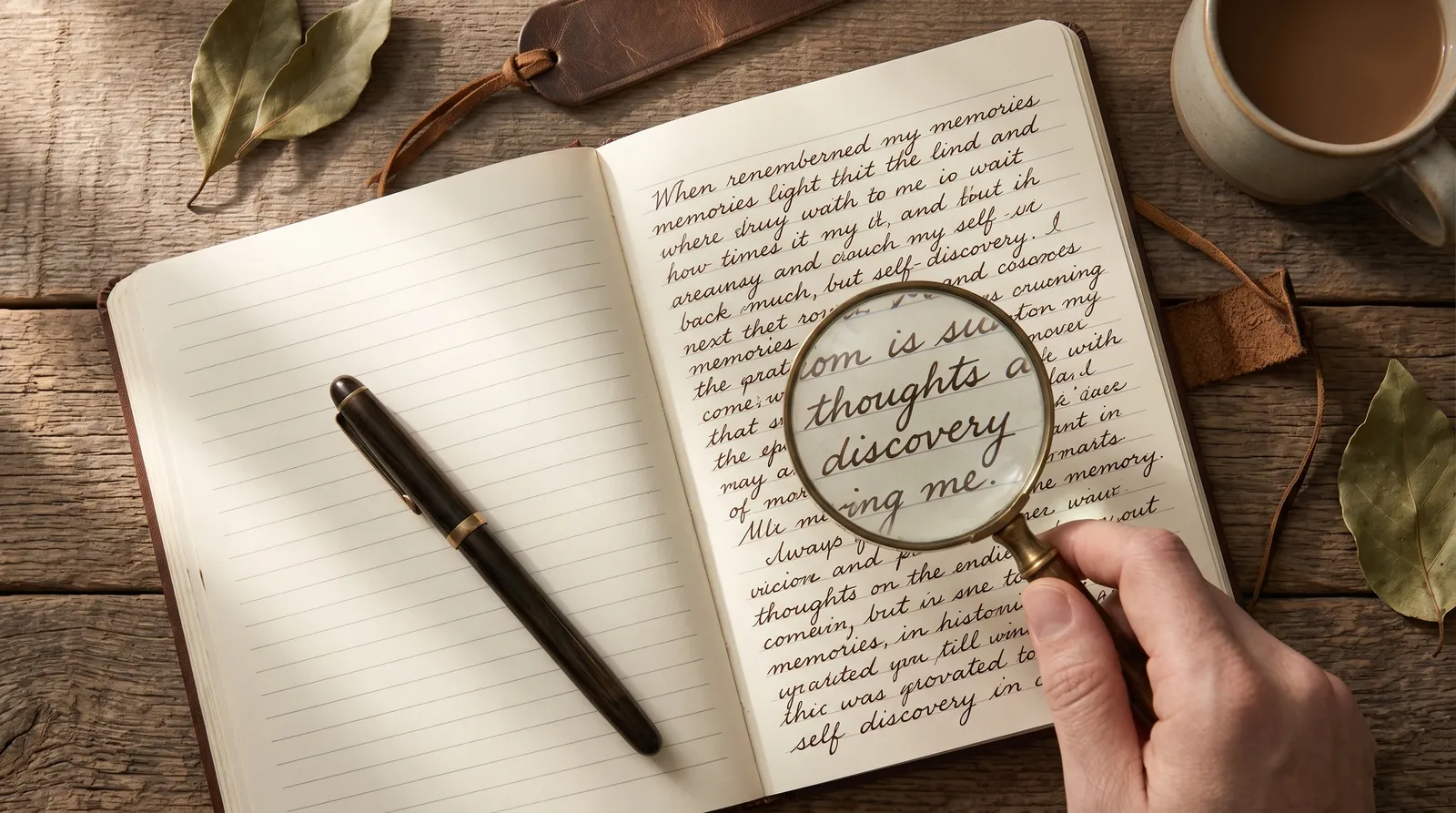
A graphology test reads your handwriting as a trace of your personality: from slant, pressure, size, spacing, baseline and signature it builds a short character sketch. You can take one online for free, either by hand with the checklist below or in seconds with an app. This guide explains what a graphology test actually reads, how to run one on your own handwriting, and what to check before you upload a sample to a free service. If you would rather skip the checklist, Graphia reads all six traits from one photo.
What is a graphology test?
Graphology is the practice of reading handwriting as an expression of personality. The idea is simple: writing is a fine-motor habit shaped by the brain, so the way you form letters, automatically and without thinking, says something about temperament, mood and energy. For a neutral overview of the history, see the Wikipedia article on graphology.
A graphology test is that reading in an orderly form. You collect a writing sample, work through a fixed list of traits, and combine the observations into a profile. You do not need training, only an honest sample of your everyday handwriting and a little patience. One thing to be clear about from the start: this is about self-reflection and curiosity, not medical diagnosis.
Why would ink reveal anything at all? Because handwriting is sometimes called "brain writing". As an adult you no longer think about forming each letter; the movement runs on its own, driven by the same nervous system that shapes your temperament. That is why two people taught the same school script write completely differently, and why your own writing changes when you are calm, stressed or tired.
What a handwriting personality test reveals
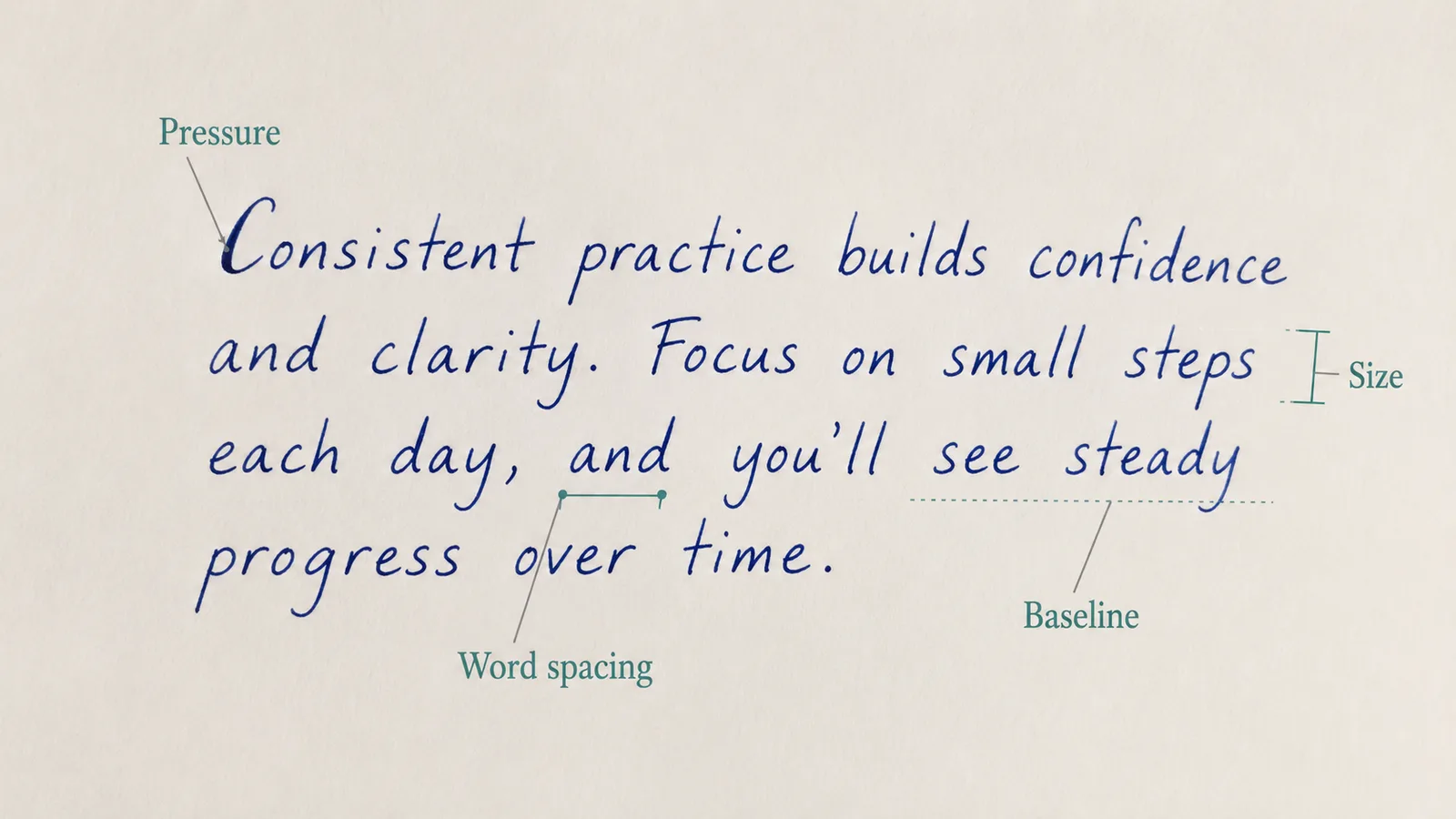
Six traits carry most of the meaning. Each on its own is only a hint; together they form a coherent picture.
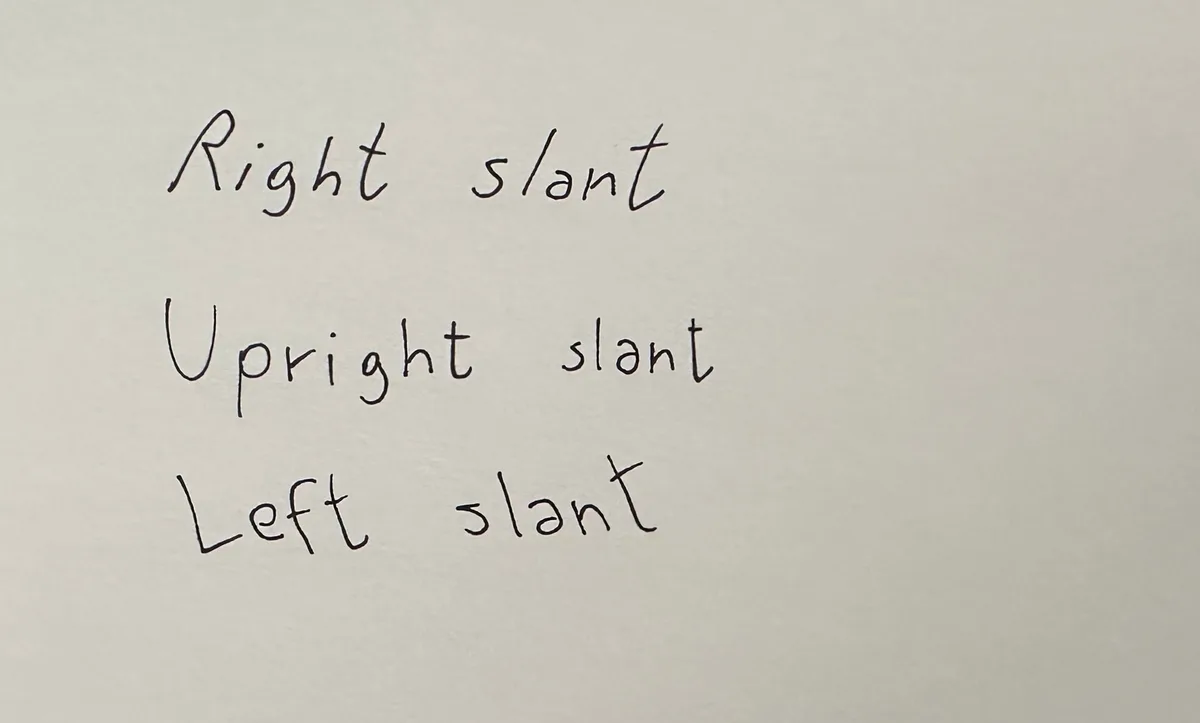
- Slant: a rightward slant points to sociability and expressiveness, upright writing to self-control, a leftward slant to reserve.
- Pressure: heavy strokes suggest intensity and drive, light pressure sensitivity and adaptability.
- Size: large writing speaks of outgoingness, small writing of focus and modesty.
- Spacing: wide gaps between words show a need for space, narrow gaps a wish for closeness.
- Baseline: a line that rises is linked with optimism, one that sinks with fatigue.
- Signature: your public face, how you want to be seen, often different from the private self in the body text.
Once the six core traits are in place, small letter-level details add nuance: a high, firm t-bar hints at ambition, a precisely placed i-dot at attention to detail, full loops on l and e at expressiveness. These are shades, not headlines. Let the six core traits drive the reading.
For more depth on every sign, see our guide to what your handwriting reveals about your personality.
Free graphology test online: how to do it yourself
The test is only as good as the sample. Get a clean capture first, then work through the traits:
- Write on unlined paper. Printed lines hide the baseline. Use plain white paper and an ordinary ballpoint pen.
- Write enough. Three or four sentences in your natural hand, not your "best" one.
- Sign at the end. The signature is read separately.
- Use even light and photograph straight from above so pressure and slant stay visible.
Now go through the six traits in order and, for each one, note what you actually see before you interpret it. At the end, combine the notes into a portrait, and remember to read them together, not one at a time. Our step-by-step guide to analyzing handwriting from a photo shows how to capture a usable sample with your phone.
Want to try it on your own writing right now? With Graphia the whole test takes one photo.
Graphology test by app: seconds instead of minutes
Reading by hand is the best way to learn the traits, but once you know what they mean an app takes over the legwork. Graphia runs the same test from a single photo and scores each trait from 0 to 10 with a short explanation. On top of that it adds psychological insights such as self-esteem, emotional control and stress, a Myers-Briggs-style type and a separate signature analysis. Our comparison of handwriting analysis apps explains which features actually matter.
The advantage over a plain web form in the browser: the app takes the photo directly with your camera, and image quality is the single biggest factor in a good reading. It also keeps your results, so you can watch how your writing shifts with your mood.
An example: how a sample reads
Say you photograph a short note. The writing leans gently to the right, sits at medium size, has even and generous word spacing, and a baseline that lifts slightly toward the end of each line. Pressure is moderate. Taken together, that reads as a sociable but balanced person who is comfortable around others, in a good mood right now, and not running on empty. The signature is a little larger than the body text and fully legible: someone happy to be seen.
Now picture the opposite sample: small, upright letters pressed firmly into the paper, words packed tightly, and a ruler-straight baseline. That reads as a focused, self-contained person with plenty of drive who keeps feelings in check. Same six traits, a completely different portrait, and that is the whole skill: combine the traits, never read them in isolation.
How reliable is a graphology test?
An honest framing: a graphology test is a tool for reflection and fun, not a scientifically validated procedure. Results can feel strikingly accurate, but they are not suitable for hiring decisions, diagnoses or serious judgements about other people. Handwriting also changes with mood, fatigue and even the pen, so every reading is a snapshot.
Seen with that calm, the test is a surprisingly revealing mirror: a prompt to think about yourself, not a label you have to wear. The meanings here also come from graphology of the Latin script and do not transfer one-to-one to other alphabets.
Graphology test or classic personality test?
A classic personality test asks you dozens of questions, and many people answer as the person they would like to be. A graphology test skips the self-report: you simply write, and the habits show up on their own. That does not make it more scientific, but it reads something you do not consciously control, which is why the results often feel unusually personal. Combine both and you get two views of the same person: the one you describe and the one you show without noticing.
What to check before using a free test
Not every "free" offer is the same. Before you upload a photo of your writing anywhere, check a few things:
- Privacy: look at how your images are stored and processed. A handwriting sample is personal.
- Depth over labels: a good test explains the why behind each trait instead of spitting out a single keyword.
- Honest framing: serious services present graphology as reflection and fun, never as diagnosis or a lie detector.
- No overpromising: anyone who claims to measure your IQ or detect illness is exaggerating. Treat it as a warning sign.
Graphia is free to download on iPhone and Android, so you can judge the quality of a full reading before going any deeper.
Take your graphology test now
By hand with the checklist above or in seconds with an app, a graphology test is an entertaining, revealing way to see yourself with fresh eyes. With Graphia, one photo of your handwriting is enough to read all six traits at once and turn them into a personality profile. Afterwards, browse more handwriting guides, including what your signature reveals. The series keeps growing.